Where Is Generative AI on the Diffusion of Innovation Curve?
From experimentation to enterprise adoption, Generative AI may be approaching its most important transition yet.
When ChatGPT was released publicly in late 2022, Generative AI suddenly moved from research labs and specialist communities into everyday life. Within a remarkably short period, millions of people began experimenting with AI to write, summarize, code, brainstorm, analyze information, and create content.
But experimentation is not the same as adoption.
And adoption is not the same as transformation.
Today, the more interesting question is no longer:
“Will people use Generative AI?”
It is:
“Where are we in the adoption cycle — and what happens next?”
One useful way to explore this question is through Everett Rogers' Diffusion of Innovations theory.
The Diffusion of Innovation
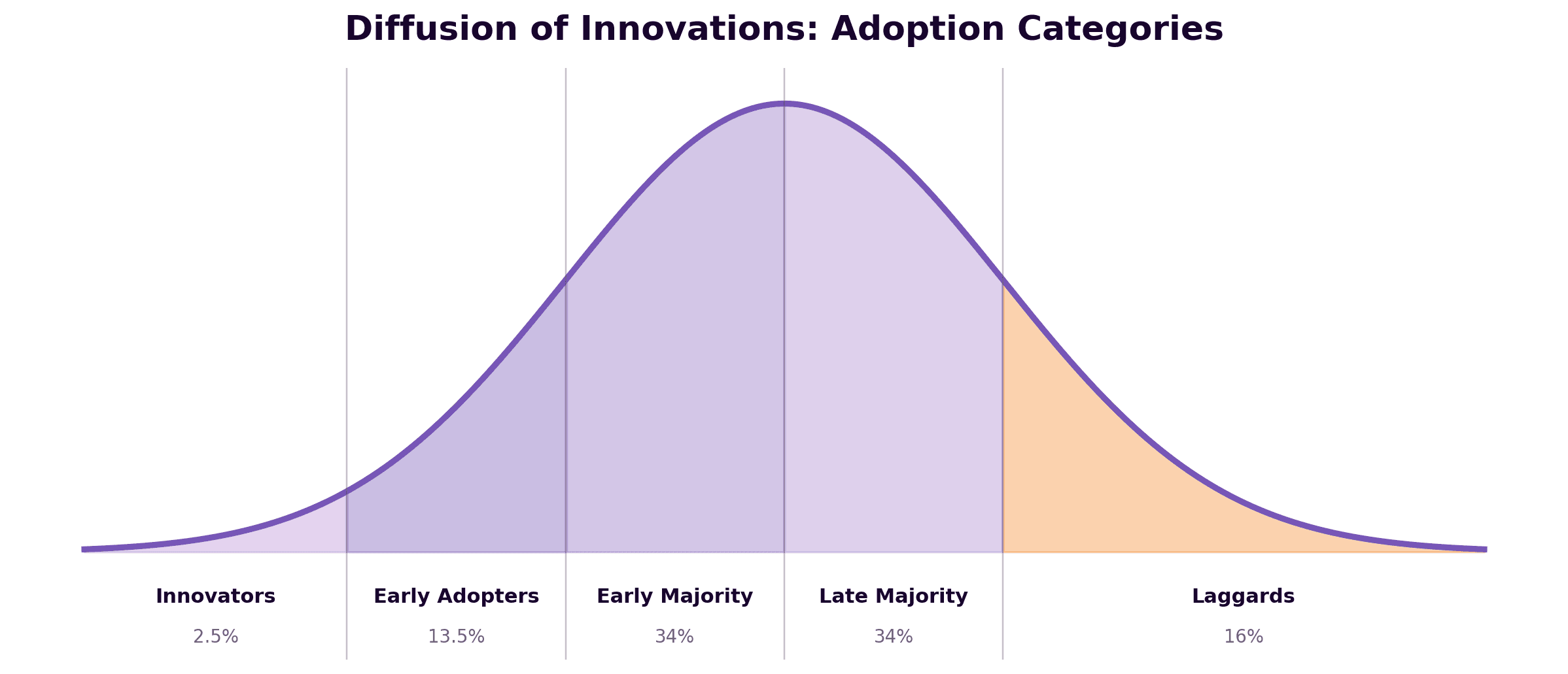
Everett Rogers developed the Diffusion of Innovations framework to explain how new ideas and technologies spread through a social system over time. The model divides adopters into five broad groups:
- Innovators — 2.5%
- The first people willing to experiment with an innovation despite uncertainty and risk.
- Early Adopters — 13.5%
- People and organizations that recognize the potential of an innovation early and begin applying it before widespread acceptance.
- Early Majority — 34%
- More pragmatic adopters. They generally want evidence that a technology works before integrating it into their activities.
- Late Majority — 34%
- More cautious adopters who tend to move after a technology has become established, less risky, or increasingly necessary.
- Laggards — 16%
- The final group to adopt, often continuing with existing approaches until change becomes difficult to avoid.
The important insight is that technologies do not spread simply because they exist. Adoption happens because perceptions change. People observe others, evaluate results, assess risks, and eventually decide whether an innovation provides enough value to justify changing established behavior.
Generative AI offers a fascinating modern example of this process.
Phase 1: The Innovators — Before the ChatGPT Moment
Long before most people had heard the term “Generative AI,” researchers, machine-learning engineers, startups, and technology enthusiasts were already experimenting with large language models, transformers, generative models, and early foundation models.
The technology was powerful, but access required considerably more technical knowledge. These were the innovators. Their primary question was:
“What can this technology do?”
They experimented because the technology itself was interesting — even when the commercial use cases were uncertain. This phase laid the technological foundation for everything that followed.
Phase 2: Early Adopters — The Generative AI Explosion
The public release of ChatGPT dramatically reduced the barrier to interacting with advanced AI. Suddenly, using a large language model did not require understanding machine learning or writing code. You could simply type a question.
This accessibility helped move Generative AI beyond innovators. Entrepreneurs, developers, marketers, consultants, designers, students, technology teams, and forward-looking businesses rapidly began experimenting with the technology.
The conversation changed from:
“What is a large language model?”
to:
“What could we build with this?”
Organizations began exploring AI assistants, content generation, coding copilots, customer-service applications, enterprise search, document analysis, Retrieval-Augmented Generation (RAG), and AI-powered automation.
Generative AI had entered its early-adopter era. But something important was still missing: proof at scale.
Phase 3: Are We Entering the Early Majority?
This is where the story becomes particularly interesting.
Recent data suggests that AI adoption has moved far beyond a small community of technology enthusiasts.
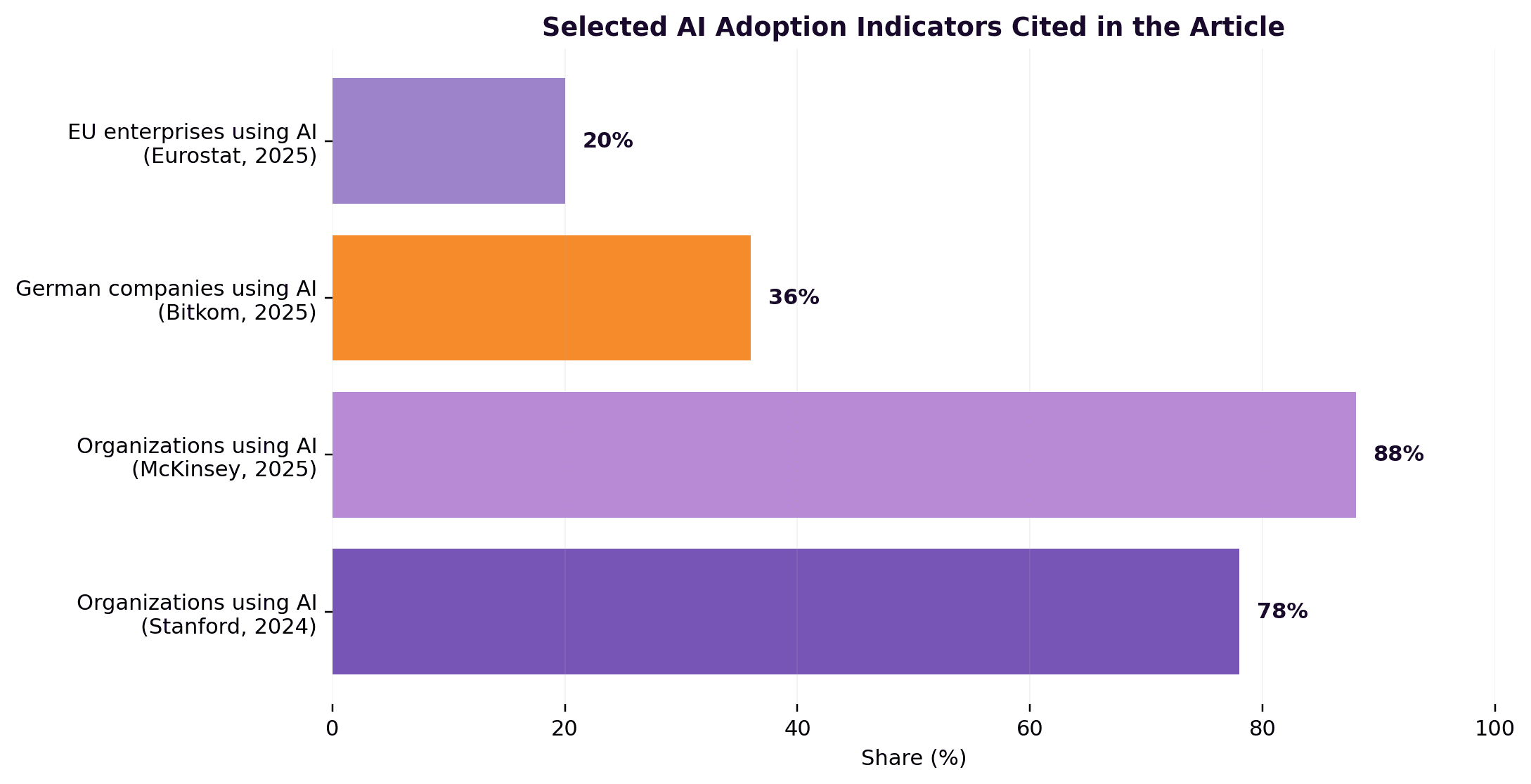
Stanford's 2025 AI Index reported that 78% of organizations surveyed were using AI in 2024, compared with 55% the previous year. McKinsey subsequently reported in its 2025 global AI survey that 88% of respondents said their organizations regularly used AI in at least one business function.
However, the same McKinsey research reveals the other side of the story: most organizations are still experimenting or piloting, and only around one-third report that they have begun scaling AI programs across their organizations.
This distinction is critical.
We may therefore be witnessing two adoption curves simultaneously:
AI tool adoption is becoming mainstream.
But:
AI transformation is still relatively early.
That is why simply saying “AI has reached the early majority” may be too simplistic. For tools such as AI chat assistants and copilots, adoption may already resemble early-majority behavior. For enterprise-wide AI transformation, autonomous agents, and deeply redesigned AI-enabled workflows, many organizations still behave more like early adopters.
The Question Has Changed
During the early phase of Generative AI, organizations asked:
“Should we experiment with AI?”
Increasingly, the questions are becoming:
- Where does AI actually create measurable value?
- Which workflows should we redesign?
- How do we connect AI with enterprise data?
- How do we control hallucinations and reliability?
- How do we protect sensitive information?
- How do we measure ROI?
- Where should humans remain responsible?
This shift from technological curiosity toward operational questions is one of the strongest signs that a technology is maturing. The conversation is moving from AI experimentation toward AI integration.
AI Agents May Be the Next Early-Adopter Wave
There is another interesting layer to the adoption curve.
While Generative AI itself is becoming increasingly mainstream, AI agents appear to be earlier in their adoption lifecycle.
McKinsey's 2025 survey found that 23% of respondents said their organizations were scaling an agentic AI system somewhere in the enterprise, while another 39% were experimenting with AI agents. However, no individual business function had more than 10% of respondents reporting scaled agent deployments.
Microsoft's 2025 Work Trend Index also illustrates the growing interest in this direction. According to Microsoft, 46% of surveyed leaders said their organizations were using agents to fully automate workflows or business processes, while 82% expected to use digital labor to expand workforce capacity over the following 12–18 months.
The exact numbers vary because these studies use different samples and definitions, but the direction is clear: the AI conversation is moving from systems that generate information toward systems that can participate in workflows and take actions.
This means that Generative AI does not have a single adoption curve. Different layers of the technology are moving at different speeds. For example:
- AI chatbots → increasingly mainstream
- AI copilots → moving toward mainstream enterprise adoption
- RAG and enterprise knowledge systems → growing enterprise adoption
- AI workflow automation → early adoption moving toward broader adoption
- AI agents → early-adopter stage
- Highly autonomous multi-agent organizations → still largely experimental
This distinction matters because the next competitive advantage may not come from simply “using AI.” It may come from understanding which layer of AI is mature enough to create value today and which technologies are still experimental.
Germany Shows Why Adoption Is Uneven
The German market provides an interesting example.
According to Bitkom, in March 2025 only 10% of surveyed German companies considered themselves AI pioneers, while 64% described themselves as laggards. But the situation was changing rapidly.
By September 2025, another Bitkom survey found that 36% of German companies were already using AI, almost twice the 20% reported a year earlier. A further 47% were planning or discussing AI adoption. Across the European Union, Eurostat reported that 20% of enterprises with at least ten employees used AI technologies in 2025, up from 13.5% in 2024.
These numbers highlight something Rogers' framework helps explain: innovation does not diffuse uniformly. Industry, company size, regulation, skills, infrastructure, leadership, perceived risk, and organizational culture can all affect the speed of adoption.
For European companies, regulation is another part of the equation. Under the EU AI Act, obligations concerning providers of general-purpose AI models began applying on 2 August 2025, introducing requirements related to areas such as technical documentation, copyright compliance, transparency, risk management, and cybersecurity.
As AI becomes embedded in business processes, the challenge therefore moves beyond technological capability. Organizations must also build governance, trust, security, and accountability around AI.
The Real Transition: From Tools to Workflows
Perhaps the biggest mistake organizations can make is treating Generative AI as simply another software tool. Opening ChatGPT and asking it to summarize an email is useful. But that alone does not fundamentally change an organization.
The larger transformation begins when businesses redesign processes around AI. Consider the difference:
- Level 1 — AI Tool
- An employee asks an AI assistant to summarize a customer message.
- Level 2 — AI Copilot
- AI helps the employee analyze the customer request and draft a response.
- Level 3 — AI Workflow
- The system classifies the request, retrieves relevant company information, prepares a response, updates the CRM, and routes the case appropriately.
- Level 4 — AI Agent
- An AI system can coordinate several tools and actions toward a defined business objective while humans supervise critical decisions.
Each level represents more than increased technical sophistication. It represents deeper organizational adoption. And that may be the real diffusion curve businesses should be watching.
The Early Majority Will Not Buy the Hype
Innovators are comfortable with uncertainty. The early majority is not. They want evidence. They want reliability. They want security. They want integration. And increasingly, they want measurable business value.
This is why the next phase of Generative AI will probably look very different from the first. The first wave was dominated by:
models, benchmarks, prompts, demos and experimentation.
The next wave is increasingly about:
processes, data, integration, governance, productivity and ROI.
In other words, the question is shifting from:
“How powerful is the model?”
to:
“What business problem does it solve?”
That is a significant transition.
Adoption Does Not Mean Transformation
One of the most important lessons from the current data is that widespread access to AI should not be confused with organizational transformation. An organization can have hundreds of employees using AI assistants while its fundamental processes remain unchanged.
Real transformation requires more. It may involve redesigning workflows, connecting AI to trusted organizational data, defining human oversight, measuring performance, training employees, managing risks, and changing how decisions are made.
This helps explain the apparent contradiction in current AI research:
AI usage is already widespread, while scaled AI transformation remains relatively uncommon.
Through the lens of Diffusion of Innovations, this is not surprising. Technologies often spread first as experiments. Then as tools. Then as processes. Eventually, the most successful ones become infrastructure.
So, Where Is Generative AI Today?
There is no single point on the curve that accurately describes the entire Generative AI ecosystem. But the evidence suggests a useful interpretation:
Generative AI as a general-purpose productivity tool is moving into the early majority.
At the same time:
enterprise-scale AI transformation remains closer to the early-adopter-to-early-majority transition.
And:
agentic AI is still largely in an early-adopter phase.
That distinction is important. The opportunity is no longer simply being among the first people to discover Generative AI. That moment has passed.
The emerging opportunity is becoming one of the people and organizations that understand how to turn AI capabilities into reliable, measurable and responsible business systems.
The winners of the next phase may not be those who experiment with the most AI tools. They may be those who answer a much harder question:
How do we turn AI from an impressive technology into a repeatable business capability?
That is where the next stage of the diffusion curve begins.
Frequently asked questions
Where is Generative AI on the diffusion of innovation curve in 2026?
There is no single point that describes the whole ecosystem. Generative AI as a general-purpose productivity tool — chat assistants and copilots — is moving into the early majority. Enterprise-scale AI transformation sits closer to the early-adopter-to-early-majority transition. Agentic AI is still largely in an early-adopter phase.
What are the five adopter categories in Rogers' model?
Innovators (2.5%), early adopters (13.5%), early majority (34%), late majority (34%) and laggards (16%). The categories describe how a population takes up an innovation over time, not how good the innovation is.
How many organizations actually use AI?
Stanford's 2025 AI Index reported that 78% of organizations surveyed used AI in 2024, up from 55% the year before. McKinsey's 2025 global survey put the figure at 88% of respondents using AI in at least one business function. But only around one-third report they have begun scaling AI across the organization.
Why is AI adoption in Germany lower than the global figures?
Bitkom found that 36% of German companies were using AI by September 2025, almost double the 20% a year earlier, with a further 47% planning or discussing adoption. Eurostat put EU enterprises with at least ten employees at 20% in 2025. Industry, company size, regulation, skills, infrastructure and perceived risk all affect the speed of diffusion — Rogers' framework predicts exactly this unevenness.
Is adoption the same as transformation?
No, and conflating them is the most common mistake. An organization can have hundreds of employees using AI assistants while its underlying processes remain unchanged. Real transformation involves redesigning workflows, connecting AI to trusted organizational data, defining human oversight, measuring performance and managing risk.
What does the EU AI Act require?
Obligations for providers of general-purpose AI models began applying on 2 August 2025, covering technical documentation, copyright compliance, transparency, risk management and cybersecurity. For European companies this means governance and accountability are now part of the adoption question, not an afterthought.
Sources and further reading
- Diffusion of Innovations framework — University of Edinburgh Research Explorer
Overview of Rogers' framework, including the five adopter categories and the factors influencing adoption.
- Stanford University — AI Index Report 2025
Reports substantial growth in organizational AI adoption and investment in Generative AI.
- McKinsey — The State of AI: Global Survey 2025
Data on organizational AI adoption, scaling and experimentation with AI agents.
- McKinsey — Generative AI usage
An earlier global survey: 71% of respondents reported regular organizational use of Generative AI in at least one business function.
- Microsoft — 2025 Work Trend Index
A global workforce study examining AI agents, digital labour and emerging human-agent teams.
- Bitkom — AI Adoption in German Companies, September 2025
36% of surveyed German companies were using AI, compared with 20% one year earlier.
- Bitkom — German Companies and AI Adoption, March 2025
Research on how German businesses perceived their own position in AI adoption.
- Eurostat — AI Use in EU Enterprises, 2025
Official EU statistics: 20% of EU enterprises with at least ten employees used AI technologies in 2025.
- European Commission — General-Purpose AI Obligations under the EU AI Act
Official information on obligations applying to providers of general-purpose AI models.
Prefer a copy to keep? Download this article as a PDF.
Comments
No comments yet — be the first to add one.